The Low Pass Filter

The Low Pass Filter used for the amplifier can also be constructed as a stand alone filter for use with any other 2 Meter Amplifier up to 200 Watts output .

The Filter was designed to bring the Harmonic & Spurious outputs generated by the amplifier module to acceptable levels ( Note within specification of the UK Amateur Radio transmitting licence harmonic spurious levels are not specified to absolute levels , these were taken from the limits specified for the adjacent commercial bands )

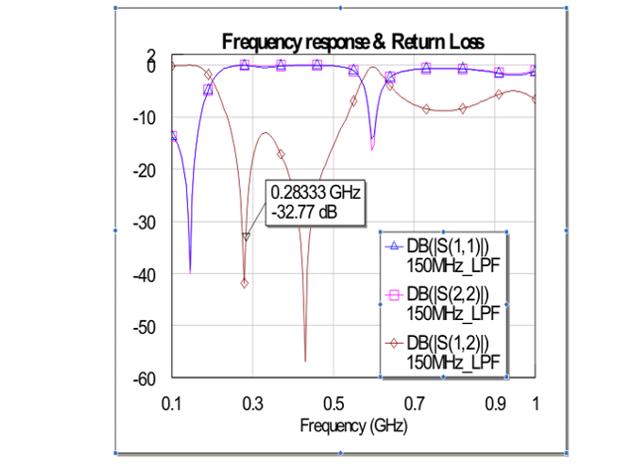
Initial designs for the filter were modelled using a commercial package called "Microwave Office " the filter response chosen to get the best roll off together with attenuating the 2nd & 3rd Harmonics is an "Elliptic " one , by selecting the notch frequencies to coincide with the relevant harmonics , the design was then made. However no account of the interconnecting tracks was taken when laying out the PCB only the transmission lines from the filter to the connectors so consequently the notches were nowhere near their intended values when first built. The filter was then redesigned using standard values of capacitors from the American Technical Ceramics " ATC 100B " series the small inductor of the 3rd Harmonic element was replaced by a printed transmission line inductive loop which is more easily fabricated . The PCB material chosen was " Rogers RO4003 - 060 - C1/C1 " to give reasonable width transmission lines given the power at which the filter is going to have to work to minimise the insertion loss with out being too large to fit the available space in the amplifier case.

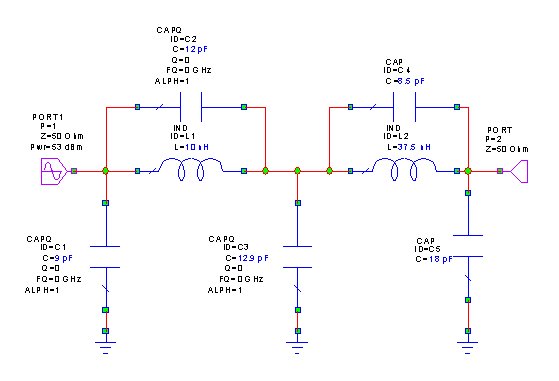
The circuit as first modelled using " Microwave Office " idealised without any PCB tracks ! The design constraints being an Insertion loss of less than 0.2dB together with losses at the trap frequencies of at least 30dB for the 2nd harmonic notch and 40 dB for the more important 3rd harmonic notch . ( there's no point in precluding cross - band operation )

7 element Elliptic filiter circuit

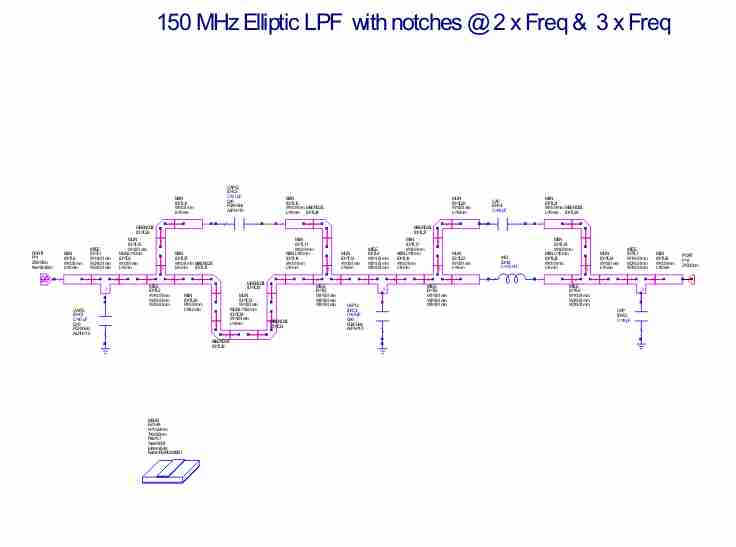
The revised filter using transmission lines for the 3f trap with the relevant PCB tracks included

Microwave office circuit of the revised filter

A screen shot of the Filter's response as calculated by " Microwave Office "

Screen shot of modelled filter response

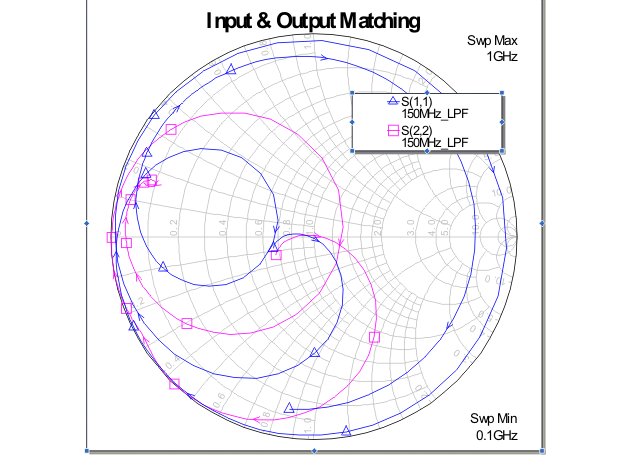
A screen shot of the Filter's impedances on a Smith Chart as calculated by " Microwave Office "

Screen shot of Smith chart

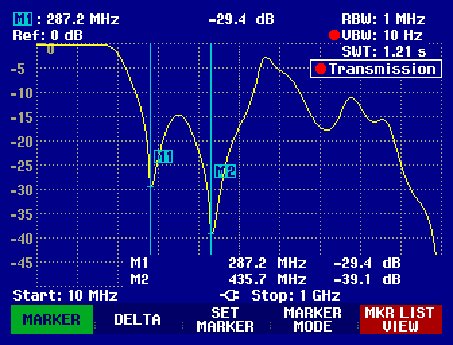
The Filter's response as measured using a Rhode & Schwarz FSH3 Spectrum Analyser

Screenshot of Filter response

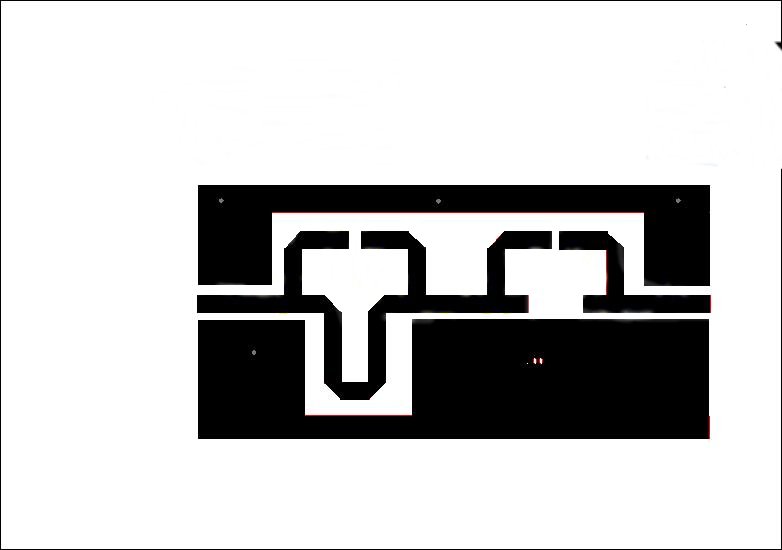
Artwork for the Filter

PCB Artwork for Filter

Link to " mirrored " artwork

The finished PCB Dimensions overall 110 mm x 55 mm

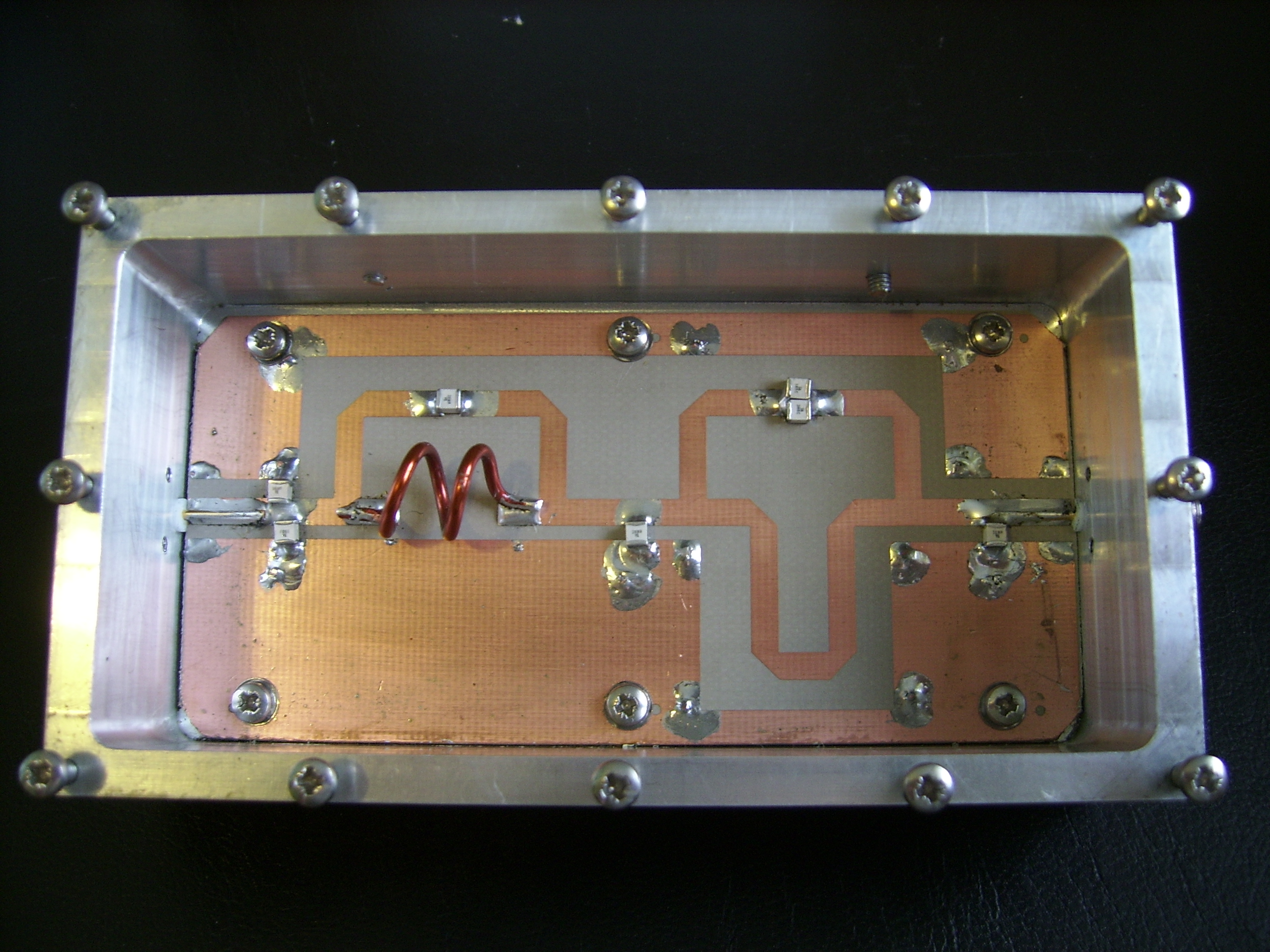
The completed 150MHz Low pass filter is shown below with the lid removed during alignment of the " 2nd harmonic " coil , note the use of multiple capacitors to get the correct value .This was due to the retailer not stocking all the parts in the range .

150MHz Low Pass Filter

CAD Drawings of the filter module

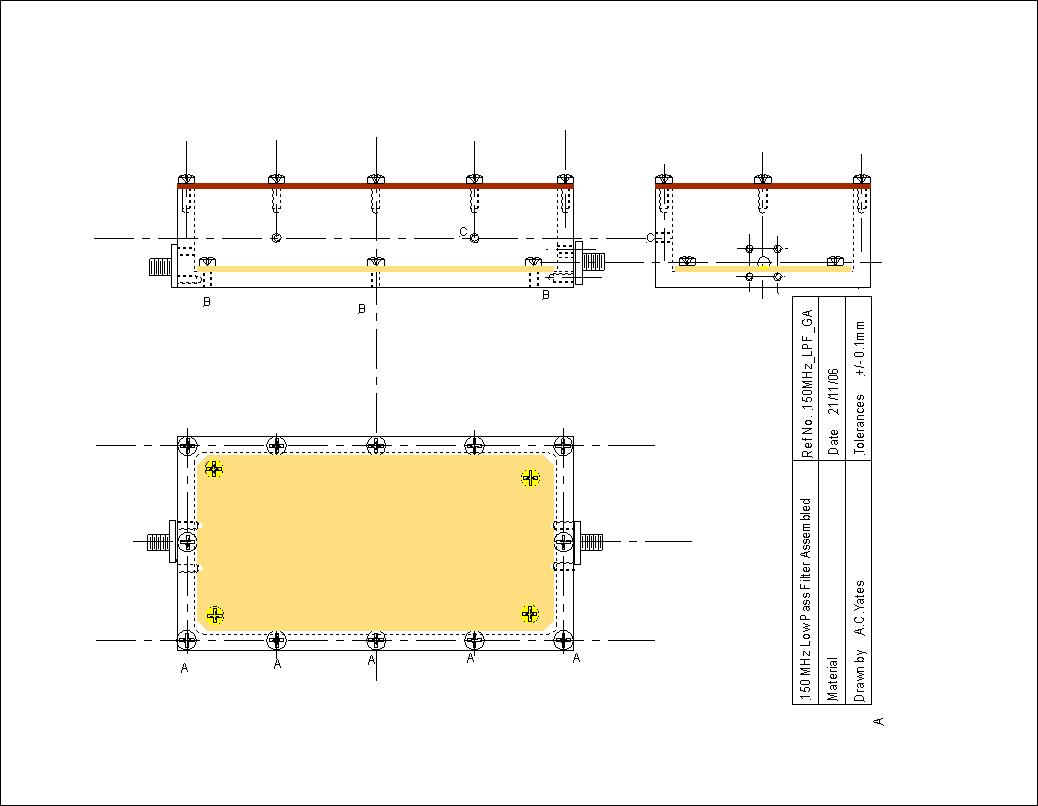
General assembly drawing for the filter

Cad view of Assembled Filter

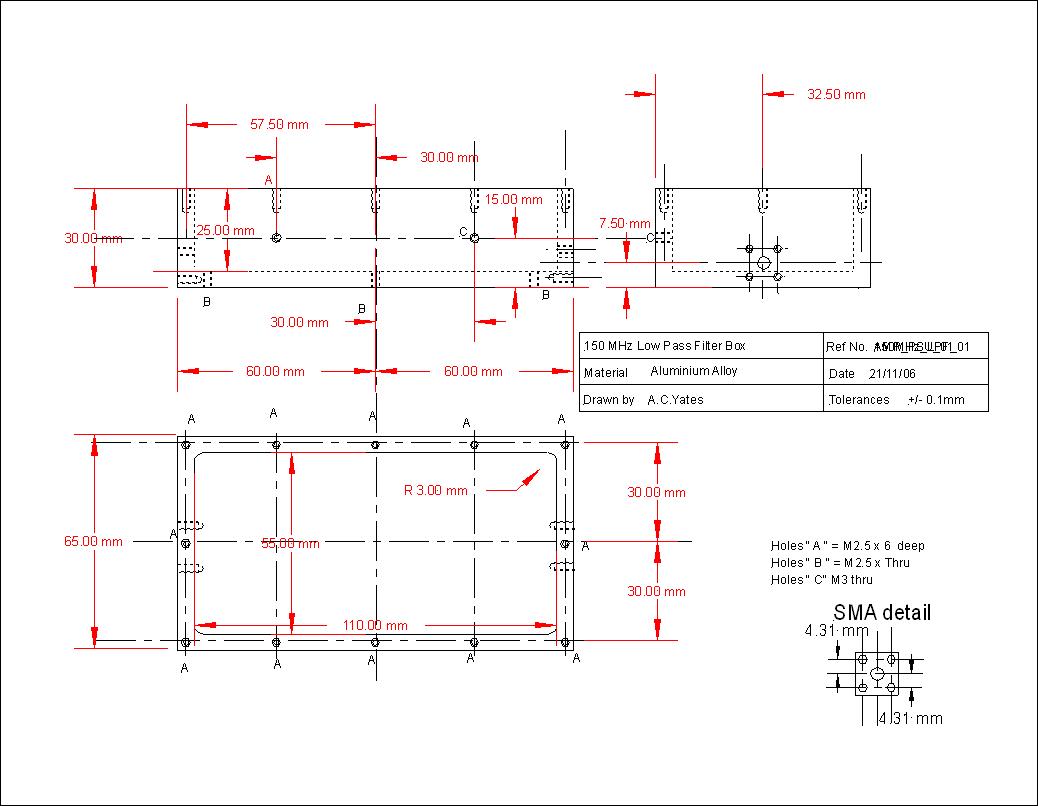
Module housing for the filter

CAD Drawing of filter housing

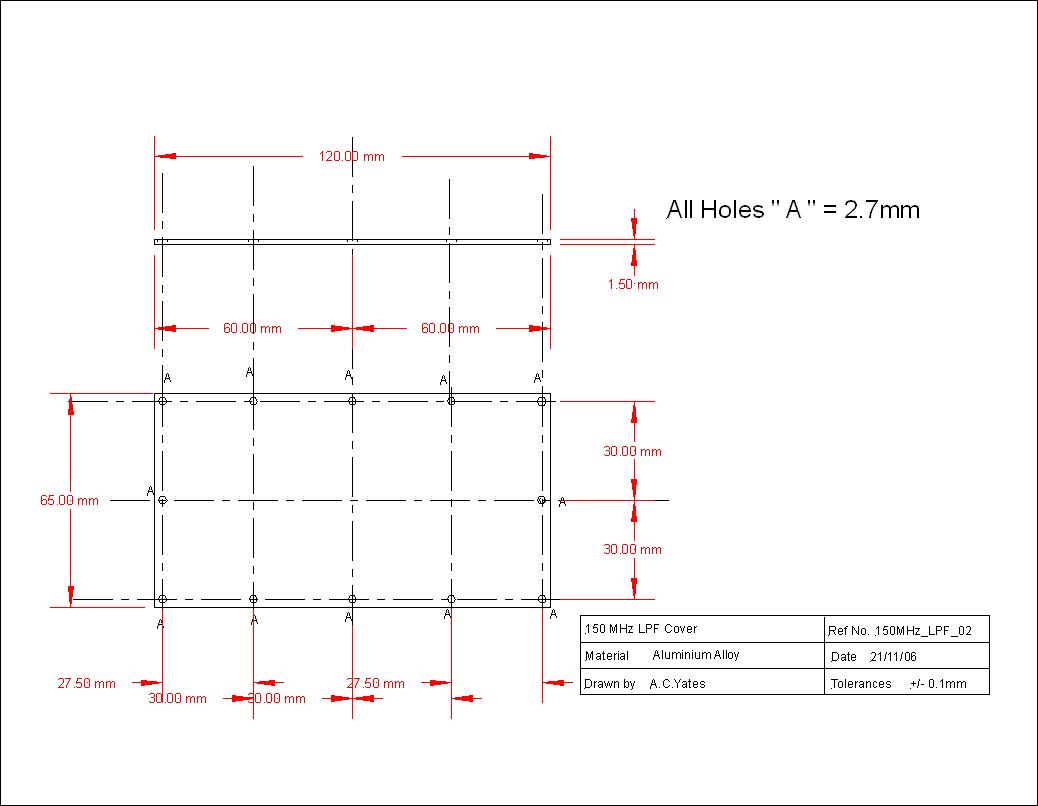
Cover for the Filter

CAD Drawing of filter cover

Parts Listing for the filter

Item

Manufacturer

Part No.

Supplier

Supplier's Part No

QTY

PCB

Homemade

Homemade

Homemade

1

SMA Socket

Various


FEC

105 - 6376

2

M2.5 x 6 mm

Various


FEC

142 - 0030

26

M2.5 washer

Various


FEC

161 - 4000

18

M3 x 6 mm

Various


FEC

142 - 0032

2

M3 Washer

Various


FEC

161 - 4001

2

Lid

Homemade


1

Case

Homemade


1

Capacitor

ATC

ATC100A1R2BT150X

RS

611 - 4335

1

Capacitor

ATC

ATC100A3R9BT150X

RS

611 - 4666

1

Capacitor

ATC

ATC100B4R7BT150X

RS

611 - 4868

1

Capacitor

ATC

ATC100B6R8BT150X

RS

611 - 4688

1

Capacitor

ATC

ATC100B8R2BT150X

RS

611 - 4964

2


Inductor


Homemade


1


Supplier codes

RS is RS Components

FEC is Farnell Electronic Components


Assembly of the Filter Module

The assembled PCB was fitted into the case with a thin film of heatsink paste under the board to ensure a good thermal path between the ground plane & the case .The PCB mounting screws M2.5 with washers were tightened up, then finally the SMA connectors were added ,fixed using M2.5 screws then soldered . The lid had a small piece of Antistatic foam glued to it to damp out any stray resonances that could be formed in the case . The LPF unit was now ready for test both with & without the lid .

Testing of the Low pass filter

Testing of the Low pass filter was done initially using a network analyser to measure both S11 ( S22 ) & S21 at low power when the alignment of the notch for the 2nd harmonic was completed ( a slight adjustment to the spacing of the coil's windings ) the lid was secured and then 10 watts was passed through the unit whilst observing the output power using the Power Attenuator & milliwatt power meter over about 10 minutes to ensure that if there were to be any failures with higher RF powers then this should show up before using the full power which could cause catastrophic failure of the filter .The filter was then tested for 5 minutes at 100 watts ( the limit of my Power Attenuator ) and repeated several times , then finally using a suitably rated load at full power (200 Watts ) the insertion loss was then re - measured to ensure no degradation of the filter's parts had occurred during the testing , there wasn't and it was still less than 0.1dB insertion loss .

Back To Amplifier Home

This page last updated 25th Oct 2009